Hybrid desk guide
Can You Use a Monitor Arm and Laptop Stand on a Small Desk?
Yes, but only if the desk still has enough room for the keyboard, mouse, and cable paths to stay usable. The real question is not whether both can fit in theory. It is whether the desk will still feel easy to work on after you add the hardware.
This guide is for the common hybrid setup where the monitor is the primary screen, the laptop still matters, and the desk is small enough that every clamp, stand, and cable route changes the layout.
Experiment
Send each reader to the live route that matches the real bottleneck
Hypothesis: readers who already know whether the monitor, the laptop, or the combined layout is the limiting factor will click faster when the matching live path appears before the rest of the setup explanation. Metric: clicks on the monitor-arm, laptop-stand, and combo pages from this guide. Keep this page unchanged through 2026-06-30 unless the setup problem itself changes.
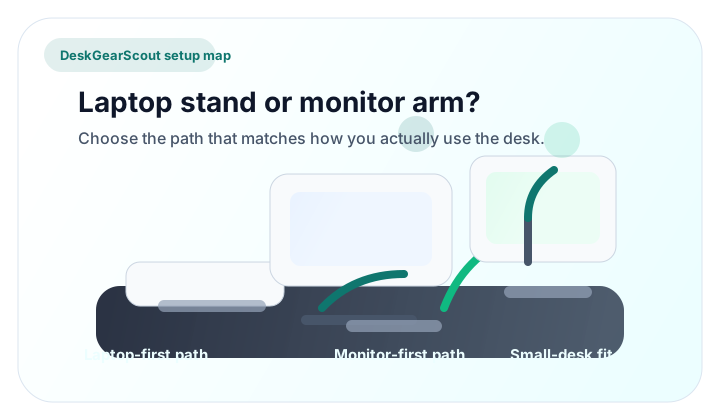
External monitor first
Open the monitor-arm route
Best if the monitor is the main screen and the desk depth problem starts there.
Laptop first
Open the laptop-stand route
Best if the laptop still drives the workday and just needs a cleaner position.
Both on one desk
Open the combo-mount path
Best if the desk needs one layout that supports both screens without turning the surface into clutter.
This guide is for small home offices where the monitor stays at the desk and the laptop still needs to stay useful instead of being fully replaced.
Fast routes
If the layout choice is already clear, move straight to the live shopping path
A small desk can support both pieces of hardware, but the faster path is usually to choose the dominant screen first and then check whether the second device still earns space on the desk. If the answer is already clear, skip the long comparison first.
Best if the external monitor is the anchor and the arm is the thing that will free the most desk depth.
Best if the laptop still matters every day and you want the cleaner, more portable upgrade first.
What usually works
The combined setup makes sense when each device has a clear job
The desk stops feeling chaotic when the monitor arm handles the stationary screen and the laptop stand keeps the secondary screen or travel machine out of the way. The point is to avoid duplicate function. If both screens are trying to do the same work, the desk usually becomes more crowded instead of more useful.
Monitor arm for the main display
Use the arm when the monitor is the screen you stare at most and you want to reclaim back-edge space.
Laptop stand for the supporting screen
Use the stand when the laptop still needs to stay elevated, visible, or part of a dual-screen workflow.
Combo mount only if the desk stays workable
If the hardware starts crowding the keyboard or mouse zone, the combined setup is no longer solving the main problem.
What to check before trying both
- Whether the monitor arm clamp has enough safe room on the desk edge.
- Whether the laptop stand will still leave room for typing and mousing.
- Whether both cables can route cleanly without crossing the work zone.
- Whether the laptop is actually needed every day or only occasionally.
- Whether one stand can do the job better than two separate pieces of hardware.
Best next pages
Use the pages that match the setup decision you actually made
If the desk is too small for both, the next page should help you choose the stronger single upgrade instead of forcing an awkward compromise.
Best if the external monitor is the main reason the desk feels cramped.
Best if the laptop still needs to stay part of the everyday workflow.
Best if you want one setup to support both devices with less separate hardware on the desk.
Best if you still need to decide which one should win rather than trying to fit both.
Best if the laptop is the secondary device and you want the simpler mixed-screen question instead of a combined hardware setup.
Best if the laptop stand is staying and you just need the placement logic to stop wasting space.
Final takeaway
A monitor arm and a laptop stand can work together on a small desk when the monitor is the fixed screen and the laptop still has a job that justifies its footprint. If the setup starts crowding the keyboard or mouse area, the smarter move is usually to pick the stronger single upgrade and keep the desk simpler.